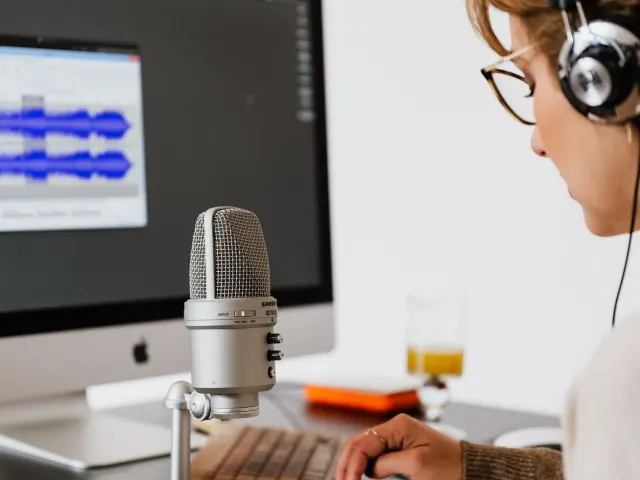

You know the words, yet fast speech still blurs together. Good english listening practice is short, active and regular: listen for the gist, check the details, then repeat.
Listening is one piece of a bigger plan, so it helps to read this alongside our guide on how to learn english.
| Item | Value |
|---|---|
| Daily listening time | 15 minutes a day |
| Active listening exercises per week | At least 3 times a week |
| Clip length for a gap-fill (cloze) exercise | About 1 minute |
| News viewing window | First 5 minutes of a bulletin |
| Suggested time for a main-ideas-then-details session | 5-10 minutes |
These figures come from Readle’s listening guide and Leonardo English’s free listening exercises. They are suggestions and can change, so check the sources before you rely on them.
Why fast speech blurs together
Struggling to follow a conversation rarely means your ears are failing. Teachers often hear learners say “I knew every word but I didn’t understand the sentence”, and the usual cause is missing multi-word chunks such as “to be honest with you”. Eslbase suggests pre-teaching 4-6 common chunks from a dialogue so they stand out when you hear them.
Real speech also relies on connected speech: linking, reductions and weak forms. Learners know should and have, but don’t recognise them in reduced form, so “should’ve” turns into a sound you have never studied.
Two more barriers are worth knowing about. Slowing a recording down doesn’t solve much, because what you often need is help hearing where one idea ends and the next begins. And the same sentence sounds different in Liverpool, Lagos, and Los Angeles, so one familiar accent never prepares you for all of them.
Each barrier has a simple fix you can try on your own:
- Chunks: write down whole phrases, not single words, whenever you hear them.
- Reduced forms: pick two or three, such as “gonna” or “should’ve”, and listen for them on purpose.
- Pauses: read a transcript and mark where you expect the speaker to pause, then check against the audio.
- Accents: replay the same topic from speakers with different voices and notice what changes.
Build a routine you can actually keep
Small and regular beats big and rare. Readle says even fifteen minutes a day of listening to English will help you improve your listening skills and expand your vocabulary, and you can combine it with walking your dog or tidying up the house. The details are in Readle’s guide.
Keep your focused exercises to at least three times a week, as the same Readle guide recommends. On other days you can simply listen to music or watch something in English for pleasure.
Choose audio at the right level. Leonardo English points out that if you need to listen multiple times to understand the main ideas, the audio you have chosen is too advanced. It also advises against multitasking or checking social media during practice time, and suggests keeping a notebook and pen nearby.
Listen in layers, from gist to detail
Treat every clip as a short project with stages, rather than playing it once and hoping. This sequence adapts the step-by-step method in Readle’s guide:
- Listen to a few minutes at normal speed without the transcript, and jot down the main ideas.
- Listen again and add the details you missed.
- Read the transcript and highlight unfamiliar words and any parts you only understood from reading.
- Listen again while following the text, and ask why you missed each part: speed, accent, connected speech or vocabulary.
- Put the text away and listen one more time, then revisit the clip a couple of days later.
You don’t need to catch every word, since you can follow the general meaning without understanding every single one. Leonardo English notes that the first time you listen you’ll catch the main ideas, and that the third listen is a great chance to note down new vocabulary. A session built this way fits the suggested time of 5-10 minutes.

Active exercises that train your ear
Passive background English helps a little. The exercises below give your attention a job to do, which is what turns listening into practice.
Dictation
A dictation is an exercise where you listen and try to write down exactly what is said, line by line. It forces you to catch small details like “have” versus “had”, and Leonardo English suggests choosing a short clip with one speaker and a transcript you can check against. You can find the method in its free listening exercises.
Gap-fill (cloze)
Take a transcript of about 1 minute, replace words you want to learn with blanks, and put it aside for around a week so you forget the answers. Then listen and fill in the cloze. Even if you remember some answers, you have still learned something, according to the same Leonardo English guide.
Shadowing
Shadowing refers to repeating the audio just after the speaker, which lets you copy their style, tone, pace and stress. Leonardo English recommends a short clip with only one speaker in a conversational tone. If shadowing makes you curious about your own sounds, our guide on how to improve english pronunciation goes deeper.
Idiom hunting
Choose a podcast with a transcript and, while listening, write down any idioms you hear. Then listen again with the transcript for any you missed. You can hunt phrasal verbs or a verb tense you have just learned in the same way, as described in Leonardo English’s exercise list.
Can subtitles and the news count as English listening practice?
Yes, if you use them as scaffolding. Leonardo English warns that watching a show with subtitles in your native language will only improve your English very slowly. A better approach is its subtitle challenge: see if you can use the subtitles less and less, switching them off for more of each series over time.
Scripted shows can also mislead you. The English in Hollywood movies and American TV shows can be spoken faster than in real life and may contain more idioms and unusual language, according to Leonardo English.
For news, try the two-language method: watch the news in your own language, then watch it in English. The same guide suggests the first five minutes only, because the main stories are likely to match across channels, so you already know what to listen for.
Turn listening into speaking
Listening is preparation for conversation, which is why it pays to use what you hear. Pick a clip on a topic people like to debate, note the speaker’s main points and whether you agree, then discuss it with a speaking partner, as Leonardo English suggests.
If you study with a partner, Eslbase offers a neat follow-up: retell the story or conversation in pairs, trying to pause in the same places as the speaker. Once you can follow a clip, our guide on how to improve english speaking skills shows how to put it to use.
Frequently asked questions
How long should I practise listening each day?
Show answer
Readle says even fifteen minutes a day helps. If your schedule is packed, it suggests combining listening with chores or a dog walk, as in its listening guide.
Do I need to understand every word?
Show answer
No. Readle notes that you don’t have to understand every single word to understand the general meaning, so keep listening past an unfamiliar word instead of stopping on it, as described in the same guide.
Why doesn’t slowing the audio down fix the problem?
Show answer
Speed is only part of it. Eslbase says that slowing a recording down doesn’t solve much, and that learners often need to hear where one idea ends and the next begins, as explained in its listening barriers article.
Is it bad to read the transcript?
Show answer
Not if you read it at the right moment. Readle recommends listening first without the transcript, then reading it to see what you missed, then listening again while following the text, in its step-by-step method.